
Fiber internet availability maps tell you whether fiber-optic service is physically deployed in your area, but they rarely reveal the full picture of what speeds you can actually purchase at your specific address. While Canada’s National Broadband Map provides a starting point for exploring broadband service availability nationwide (last updated in August 2026), business decision-makers need to understand that these tools show network presence, not guaranteed provisioning. A provider like Bell or Cogeco may indicate fiber coverage across a region, yet the infrastructure serving your particular street determines which plans you can order, creating a gap between advertised national speeds and real-world access.
This distinction matters because selecting the wrong connectivity solution can hamper your operations for years. When you’re evaluating locations for expansion or trying to upgrade your current office, availability maps serve as a first filter, not a final answer. The most effective approach involves layering map data with direct provider inquiries and understanding how different technologies stack up. Xplore, for instance, currently advertises fiber speeds up to 1 Gbps symmetrical in select regions while also offering 5G and 5G Ultra services, illustrating how providers blend multiple technologies to fill coverage gaps.
For IT professionals building a resilient information systems solution fiber availability isn’t just about bandwidth. It’s about reliability, latency, and future-proofing your infrastructure. The guide that follows breaks down how to read availability maps accurately, interpret what providers actually deliver versus what they advertise, and translate that research into informed decisions that support your business continuity and growth. We’ll also show you how Stream IT’s 24/7 support and personalized consultation process can bridge the gap between map research and deployment reality.
What Fiber Internet Availability Maps Actually Tell You (And What They Don’t)

Fiber internet availability maps display where providers claim to offer service, typically showing coverage zones shaded by technology type or maximum advertised speeds. These interactive tools, including resources like the National Broadband Map that helps Canadians explore broadband service availability nationwide, plot network infrastructure footprints across regions and let you search by address or postal code. When you enter your business location, the map returns a list of providers reporting coverage in that area, along with their advertised technology types and speed tiers.
What these maps actually show is provider-reported coverage boundaries, not guaranteed service at your specific address. A provider marks an entire census block or service area as covered if their network infrastructure runs somewhere within that zone, even if fiber doesn’t reach every building on every street. The map indicates potential availability based on network proximity, not confirmed connection capability at your exact coordinates.
This creates the most common misconception: assuming that presence on the map equals immediate service at advertised speeds. Bell and Cogeco might show fiber coverage for your postal code, while the actual last-mile connection to your building relies on older copper infrastructure requiring costly extensions. Similarly, Xplore currently advertises fiber speeds up to 1 Gbps symmetrical in select regions, but “select regions” means specific communities within broader coverage zones, not blanket availability everywhere the map shows Xplore service.
Maps also don’t reveal installation timelines, construction requirements, or whether a provider actively markets to commercial customers in your area. Some display technology portfolios (like Xplore’s current offerings including 5G and 5G Ultra alongside fiber) without clarifying which technology serves which addresses. The displayed maximum speeds represent best-case scenarios under ideal conditions with direct fiber connections, not the baseline you’ll automatically receive.
Availability maps function as screening tools that narrow your provider list, not definitive answers about what you can actually purchase. They tell you where to start your investigation, which providers operate infrastructure near your location, and what technologies theoretically reach your area. Confirming real service capability requires the verification steps that follow.
How to Read Availability Maps for Business Internet Decisions

Start with the availability layer before anything else. When you open a fiber internet availability map, enter your business address and note which providers show service at that location. Don’t get distracted by speeds or pricing yet, your first question is simply “who claims they can reach this address?” Many decision-makers make the mistake of comparing plans from providers who can’t actually service their location, wasting time on options that were never viable.
Once you’ve identified available providers, shift to the technology layer. A provider may advertise a national speed, but the network serving your road decides what can actually be ordered. Look for explicit “fiber” or “FTTH” (fiber-to-the-home) designations rather than generic “high-speed” labels. Some maps use colour coding or icons to distinguish fiber from cable, DSL, or fixed wireless. If the map doesn’t specify technology type at your address, that’s a red flag requiring direct verification with the provider.
With availability and technology confirmed, examine the plan details shown on the map. Note maximum advertised speeds, but understand these represent the ceiling, not guaranteed performance. A map might show 1 Gbps fiber available, yet installation reveals only 500 Mbps is actually deployable at your specific premises due to infrastructure constraints. Pay attention to whether speeds are symmetrical, upload matching download, since business applications like cloud backups and video conferencing depend heavily on upload capacity.
Cross-reference multiple map sources rather than relying on a single tool. The National Broadband Map provides a government-verified view of service availability across Canada, but individual provider maps sometimes contain more recent infrastructure updates. When these sources contradict each other, the more conservative estimate is usually closer to reality.
Test the map’s granularity by entering adjacent addresses. If your business sits on a street where availability changes block by block, the map may default to showing neighborhood-level data that doesn’t reflect your precise location. Buildings on opposite sides of the same street sometimes fall under different network segments with drastically different service options.
Finally, treat any map indication as preliminary data requiring confirmation. The map tells you where to focus your investigation, not where to stop it. Before making infrastructure decisions, you’ll need direct provider quotes specifying exact speeds, service level agreements, installation timelines, and whether your address requires construction to enable fiber access, details no map can reliably display.
Canadian Fiber Internet Landscape: What the Maps Show in 2026
Canada’s fiber internet landscape in 2026 reveals a patchwork of availability that varies dramatically by region, with established carriers dominating urban markets while newer technology portfolios expand into underserved areas. The National Broadband Map provides the most comprehensive view of this coverage, offering an interactive tool that helps businesses explore broadband service availability across the country with data updated through August 2026.
When you examine current availability maps, you’ll notice that major providers like Bell and Cogeco maintain strong fiber footprints in their established territories, typically concentrated in Ontario, Quebec, and select urban centres across other provinces. Their infrastructure investments have created dense fiber networks in cities and surrounding municipalities, but coverage thins considerably in rural and remote business locations.
| Provider Type | Technology Portfolio | Coverage Focus |
|---|---|---|
| Established Carriers (Bell, Cogeco) | Fiber to the premises, cable hybrid networks | Urban centres, established municipalities, high-density corridors |
| Emerging Providers (Xplore) | Fiber up to 1 Gbps symmetrical, 5G and 5G Ultra | Select regions, expanding into underserved markets |
| Regional Carriers | Mixed fiber and legacy copper, wireless alternatives | Provincial territories, rural communities |
The evolution beyond traditional wireline infrastructure has introduced complexity to availability maps. Xplore currently advertises fiber speeds up to 1 Gbps symmetrical in select regions, while also maintaining a technology portfolio that includes 5G and 5G Ultra services. This multi-technology approach reflects a broader industry shift, where providers increasingly combine fiber, fixed wireless, and 5G broadband options to expand coverage beyond areas where fiber installation proves economically challenging.
What the maps don’t immediately show is how this technology mixing affects actual service capabilities. A provider may advertise a national speed, but the network serving your specific road determines what can actually be ordered. This disconnect between mapped coverage and deliverable service becomes particularly relevant during the 4G to 5G transition where wireless technologies fill gaps but don’t always match fiber’s consistency for bandwidth-intensive business applications.
The current Canadian fiber landscape rewards methodical research. Start with availability, then examine technology type, then evaluate specific plans for your location. Maps provide the initial filter, but they represent infrastructure potential rather than guaranteed service at your business address.
Beyond the Map: Validating Fiber Availability for Your Business Location
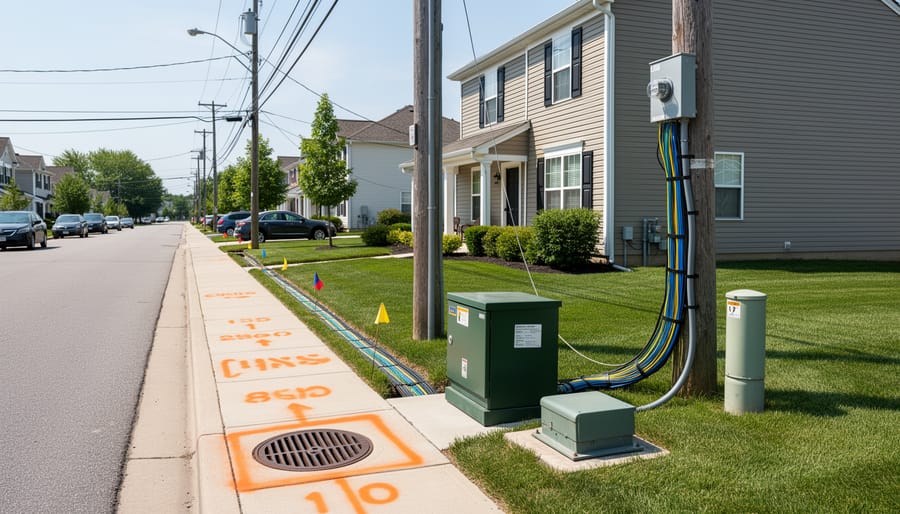
Availability maps provide direction, but they can’t guarantee service at your specific address. The next step requires direct verification with providers who appear on the map for your location.
Start by contacting providers individually with your exact business address. Ask not whether fiber is “available in your area” but whether they can deliver fiber to your precise location, street address, suite number, building details. Request quotes in writing that specify technology type, speeds, installation requirements, and timeline. What appears as fiber coverage on a map may actually indicate fiber to a nearby node with copper delivery to your building.
Installation timelines matter as much as availability. A provider advertising fiber service might quote twelve weeks for installation at your site because underground conduit must be laid, permits obtained, or building infrastructure upgraded. Ask about construction requirements, property access needs, and who bears installation costs. Some business locations require significant infrastructure work even when fiber runs past the building.
Service level agreements deserve careful review before committing. Compare guaranteed uptime percentages, response times for outages, remediation procedures, and penalties for service failures. A business-class SLA with 24/7 support and rapid response typically costs more than residential-grade fiber but provides protections your operations may require. Understand exactly what “fiber internet” means in the contract, some agreements deliver fiber to your building but transition to copper for the final connection, affecting performance.
Working with an IT solutions partner streamlines this verification process. Experienced professionals can contact multiple providers simultaneously, interpret technical specifications, negotiate terms, and assess whether proposed solutions align with your infrastructure needs. They evaluate not just advertised speeds but actual network capacity during business hours, latency for cloud applications, and how fiber connectivity integrates with your existing systems. This approach saves time and ensures you’re comparing equivalent service levels rather than marketing descriptions.
Making Fiber Internet Work for Your Business Infrastructure
Securing fiber internet is just one piece of your business infrastructure puzzle. The real value emerges when fiber connectivity integrates seamlessly with your cloud services, computer networking, structured cabling, and telephony systems. A 1 Gbps fiber connection underperforms if your internal network can’t handle the throughput, or if outdated cabling creates bottlenecks between your internet gateway and workstations. Cloud-based applications demand both speed and reliability, fiber provides the bandwidth, but your network architecture determines whether remote teams experience smooth collaboration or frustrating lag.
Effective infrastructure planning starts with understanding your actual usage patterns. A manufacturing facility streaming real-time equipment data to cloud analytics platforms has different requirements than a financial services firm handling secure client communications. Neither fits a one-size-fits-all approach. The availability map tells you where fiber exists, but IT connectivity support helps determine how fiber fits your operational needs, whether that means configuring redundant connections for mission-critical systems or designing network segmentation for security compliance.
This personalized approach reflects genuine client centricity. Small businesses benefit from the same infrastructure planning rigor as enterprise clients because reliable connectivity matters equally regardless of company size. When telephony systems integrate with fiber internet through properly configured quality-of-service settings, call clarity improves. When structured cabling meets current standards, your fiber connection performs at its rated speeds. These details separate functional connectivity from infrastructure that actually drives business productivity, and they require expertise beyond simply ordering the fastest available plan.
Fiber internet availability maps provide valuable insight into potential connectivity options, but they’re starting points for your business infrastructure decisions, not definitive answers. The gap between what maps display and what’s actually available at your specific address requires verification, professional assessment, and often negotiation with multiple providers to secure reliable service.
For business decision-makers, the most strategic approach combines map research with expert guidance from IT professionals who understand both the technical requirements of your operations and the realities of Canadian connectivity infrastructure. Rather than navigating provider claims, service level agreements, and installation timelines alone, working with dedicated partners ensures you get solutions tailored to your actual needs, whether you’re running a three-person startup or a growing enterprise.
At Stream It, we help businesses across Canada cut through availability data to find, verify, and implement fiber internet solutions that integrate seamlessly with your broader IT infrastructure. Our team provides personalized service matched to your specific requirements, backed by 24/7 support that keeps your connectivity reliable long after installation. If you’re ready to move beyond maps and secure the fiber internet your business actually needs, contact us today to discuss your connectivity goals.